|
To
Specifying Engineers:
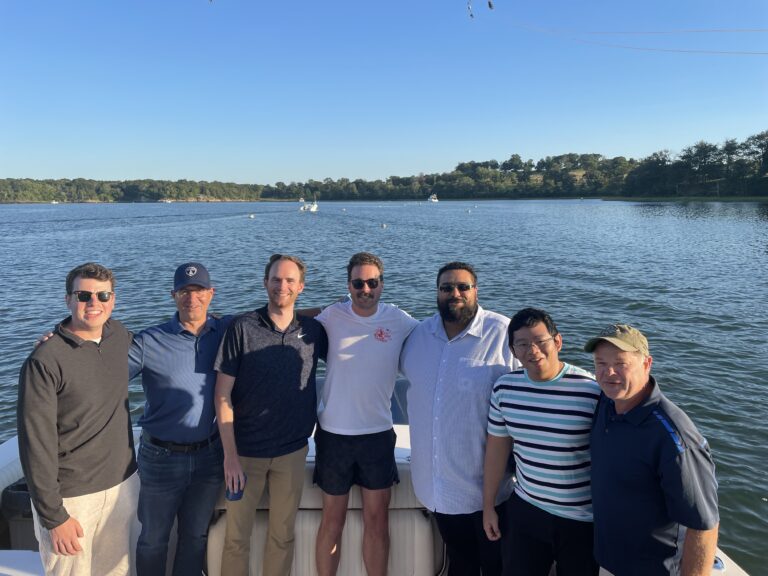
Buckley Associates, Price Industries, and Greenheck Fan Corporation recently hosted a group of Boston area acoustical consultants from Acentech and Cavanaugh Tocci Associates for a tours of their acoustical testing facilities. The three day long event included stops in Winnipeg, Manitoba and Schofield, Wisconsin.
Day 1: Price Industries
On the first day the group had the opportunity to observe sound tests of fan powered terminals with and without discharge attenuators. They also learned about Price noise control products and applications for commercial and industrial markets; and selection software available from Price. In addition to the acoustical consultants, Eric Edman of BR+A Engineers was also in the group, adding his perspective as an experienced HVAC design engineer with an interest in noise control.
Day 2: Greenheck Fan Corporation
The following day the same group visited Greenheck Fan. The morning was a presentation on the Greenheck product line and recent innovations in noise control and energy efficiency. This was followed by a tour of the Greenheck customer center with displays of different products, including an Energy Recovery unit with glass side panels to show all the internal components, and a live comparison of a an axial fan, inline centrifugal fan, and mixed flow fan at the same cfm and static pressure. The afternoon featured a tour of Greenheck production lines, chambers for testing fan noise, and vibration test rig.
Tim Foulkes of Cavanaugh Tocci Associates had this to say about the trip:
"This was a valuable experience that will bolster my understanding of fan systems and noise control. Both of these companies are so much larger than I had imagined, with amazing facilities for testing acoustics and airflow. At the same time it was a great opportunity to meet the Greenheck and Price engineering staff in person, and a lot of fun travelling with my colleagues from Buckley Associates and Acentech."
Get A Tour of the Price Sound Lab (Video)
Acentech Thank You Letter
In this month's Buckdate, our team of product specialists have prepared articles with relevant technical data and product application information.
|
| |
|
Greenheck Introduces Lab Exhaust with Sure-Aire Variable Volume Exhaust Technology
Bob Sirois
Greenheck continues to be a leader in lab exhaust market, they were the first with AMCA-260 certified dilution blowers and they are now first to develop a variable nozzle to accomplish VAV without the need to run the fan constant volume.
This new system combines airflow measurement utilizing their Sure-Aire system, with a new adjustable geometry discharge nozzle. This will enable the fan to turn down at the same time the lab turns down, by adjusting the nozzle geometry to maintain 3000 fpm discharge velocity.
The benefits are reduced fan energy, lower sound when turned down, discharge velocities maintained at ANSI Z9.5 minimums, airflow monitoring, potential LEED credits or possibly energy rebates. Greenheck continues to build value in air movement.
Greenheck Vektor-HS with SAVVE Technology
|
Constant Volume Series versus Variable Volume Parallel Flow Fan Powered Terminals
Steve Nemec
For a number of years the trend in fan powered terminal design has been in favor of constant volume (Series Flow) boxes. The major reason was the noise associated with intermittent fan operation and the associated occupant misconception that the fan had something to do with fresh air or heating and cooling. With designers looking for every avenue to save energy it may be time to take a fresh look at variable (Parallel Flow) terminals. Consider the significant points below:
- Most system designs size the heating air volume at 50% of the primary cooling air volume. In the case of VAV design this allows for the fan to be sized for this reduced volume with the following benefits
- Motor HP and fan diameter reduced for energy consumption (See the attached comparison, Constant volume requires a ½ HP motor while the Variable volume is 1/8HP)
- Sound levels can be significantly reduced by approximately 5 NC
- The fan only operates during the heating cycle further conserving energy
- Reduced or smaller footprint, more available plenum space
- Reduced Cost of VAV Box
- Enter the ECM motor. The ECM motor can be programmed to ramp up slowly in lieu of the PSC motor which is activated at a pre-selected speed minimizing the perceived sound concern referenced above. The ECM motor can also mimic a Constant volume box sequence operation. Price has designed a control strategy (See attached control strategies) for this application.
- Why not locate the reheat coil at the return/plenum inlet in lieu of the fan discharge? We essentially decouple the cooling terminal from the fan powered component of the terminal eliminating the static pressure penalty associated with the coil.
Its certainly time to take a hard look at the advantages of VAV fan powered terminals. Please contact us for additional information.
Power Comparison FDC5 verses FDV5
Fan Powered VAV Control Strategies
|
American Aldes Recovery Technology
Rick Knowlton
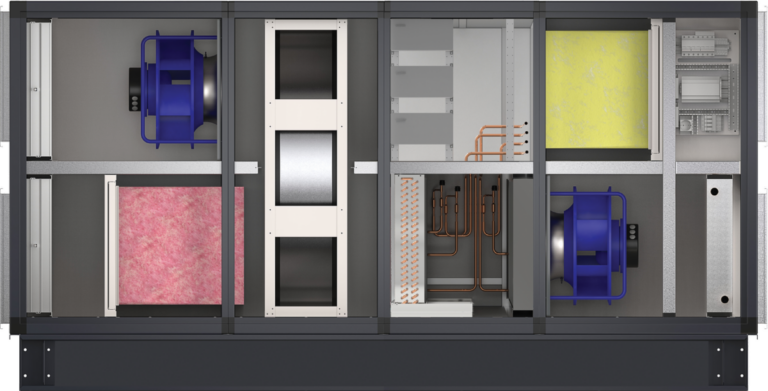
Buckley Associates is excited to represent a new line of commercial plate type heat and energy recovery ventilators manufactured by American Aldes. A global leader in ventilation solutions for over 40 years, American Aldes offers the most advanced HRV and ERV units designed and built to meet any application, and to meet ASHRAE 62 or LEED platinum certification.
The list of applications is long and includes, among others: commercial offices, hotels, hospitals, schools, restaurants, medical offices, and retail stores. A wide range of units are available, including commercial HRVs and ERVs ranging from 250 CFM up to 4,500 CFM, and customizable units up to 10,000 CFM with heating and cooling coils, multiple cores, and building automation control.
Not only are they infinitely customizable, these units are uniquely suited for the New England climate. The American ALDES dpoint enthalpy core is an advanced polymer material that provides significant health benefits and energy savings for buildings and their occupants. The dpoint core can recover more than 80% sensible and 40% latent energy, and includes MicroBan antimicrobial protection to resist mold, fungus, and bacterial growth. It also blocks odors and contaminants from crossing over into the fresh air stream.
Unlike paper cores the polymer core can operate in extreme climates (it can handle freezing), and with several options for frost control extends the usable temperature range of operation. It can also be washed in water to optimize recovered energy via a clean core. The dpoint core is tear and leak proof, UL flame & smoke certified, and carries a 5 year warranty. For your next application consider a product that is actually designed to operate in the Northern New England climate.
Please contact us for assistance in specifying American Aldes on your next cross-flow plate type HRV or ERV project.
ERV Cores by dPoint Technologies
Advanced Commercial HRV/ERV Systems Brochure
|
|
|
|

Download Revit models from our manufacturer's web sites:
|
Selection Software
Download product selection software from our manufacturer's web sites:
|
|